Posts

Measurement of ROS Levels and Membrane Potential Dynamics in the Intact Carotid Body Ex Vivo

Prof. D. Papkovsky and collaborators from Institute of Physiology (Essen, Germany) have contributed to the book chapter on the method of multi-parametric analysis of reactive oxygen species (ROS) in ex vivo culture of carotid body. This is the chapter from the book "Arterial chemoreceptors in physiology and pathophysiology" recently published by the Springer Publishing House. The full text can be found here .
Imaging of oxygen gradients in giant umbrella cells: an ex vivo PLIM study

Members of the lab Dr. A. Zhdanov, I. Okkelman and Prof. D. Papkovsky in collaboration with Prof. J. Cryan's lab from APC Microbiome Institute have published the research article devoted to study of intracellular oxygen (O2) gradients. While the existence of dynamic O2 gradients is a controversial topic, Zhdanov et al found that giant umbrella cells from mouse bladder epithelium display profound O2 gradients in ex vivo culture. Using confocal phosphorescence lifetime imaging microscopy (PLIM) and recently developed O2-sensitive Pt-Glc probe, they observed significant (up to 85 uM) lateral O2 gradients. Such gradients are presumably produced by mitochondrial respiration, as the authors demonstrated. The work was published in American Journal of Physiology - Cell Physiology. The full text can be found here . The image from the article was chosen as the "Image of the week" in the social media of the AJP Cell Physiology, on 14th of August.

V International Symposium "Topical problems of biophotonics-2015" and ASCOS-2015

On 20-24th of July Prof. D. Papkovsky has attended international symposium "Topical problems of biophotonics" (Volga river, Nizhny Novgorod, Russia). He presented a talk about imaging of hypoxia in 3D cultures of stem and cancer cells using phosphorescence-based nanosensors in section devoted to "Tumour and stem cells biology". More information on the event can be found here . Straight after this conference, Prof. D. Papkovsky and PhD candidate C. Kelly have attended the 9th Advanced Study Course on Optical Chemical Sensors (ASCOS) held in Porto, Portugal on 22-29th of July. Prof. D. Papkovsky delivered a talk on intracellular chemical sensing. Congratulations to Caroline, which team won the Project Group Work! 

A novel effect of DMOG on cell metabolism: direct inhibition of mitochondrial function precedes HIF target gene expression

Drs. A. Zhdanov, I. Okkelman and Prof. D. Papkovsky in collaboration with Dr. S. Melgar (Alimentary Pharmabiotic Centre, UCC) published a joint research paper reporting the HIF-independent effect of dimethyloxalylglycine (DMOG) on cell metabolism in Biochimica et Biophysica Acta (BBA) - Bioenergetics Journal. Over the recent years, DMOG was commonly used to inhibit HIF (Hypoxia Inducible Factor) pathways through inhibition of prolyl hydroxylases without paying attention to its direct inhibition of mitochondrial respiration - presumably through inhibition of "glutamine/ 2-oxoglutarate metabolic axis", as the authors suggest. The full-text of the article can be found here .

Graduation of Drs. Alicia H Waters and Alina V. Kondrashina - 180615

Image
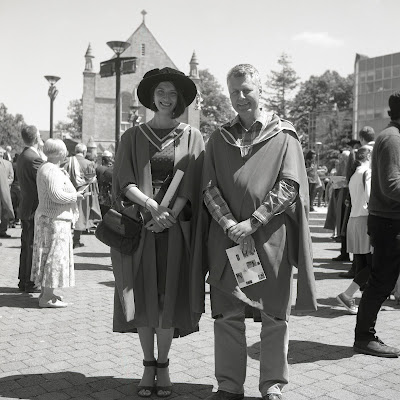
Congratulations to two fresh PhDs from the Lab, who were officially graduated last week. Congratulations to supervisor, Prof. D. Papkovsky! Best of luck Alina and Alicia in your future career(s)! Below are some photographs from the event:  Dr. A. Kondrashina with supervisor, Prof. D. Papkovsky  Dr. A. Waters and Dr. A. Kondrashina Dr. A. Kondrashina

Keystone Conference on Hypoxia, Dublin 12-17 May

Image
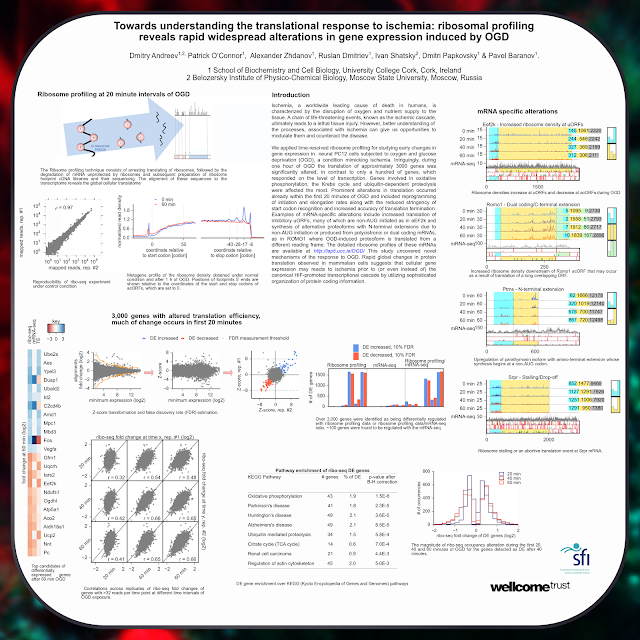
Prof. D. Papkovsky and Dr. A. Zhdanov attended the Keystone conference "Hypoxia: from basic mechanisms to therapeutics" which took place in Dublin, 12-17 May. They presented poster describing ribosome profiling study of global translation response to ischemia (recently published Genome Biology journal) and another poster on discovery of oxygen gradients in murine bladder umbrella cells (manuscript in preparation). Below is the poster on ribosome profiling:

Global translation response to brain ischemia, observed with neural PC12 cells

Dr. A. Zhdanov, Dr. R. Dmitriev and Prof. D. Papkovsky in collaboration with Dr. P. Baranov " LAPTI " group (University College Cork) and Moscow State University (Russia) have published joint research paper entitled "Oxygen and glucose deprivation induces widespread alterations in mRNA translation within 20 minutes" in Genome Biology  open access journal. The team has focused efforts on novel technique - ribosome profiling - to determine immediate effects of cellular stress occurring during ischemia (oxygen and glucose deprivation) on global protein translation. Some of the key findings of the study are: -the indication of immediate cellular response, independent from well-known Hypoxia Inducible Factor (HIF) pathway; -short-list of the key genes which translation is changed upon ischemia and -widespread occurrence of non-canonical translation initiation that can lead to synthesis of "stress-induced" forms of proteins. Collectively, this data should...