Posts

Lab photo, May 2022

Image
Tissue Engineering and Biomaterials Research Group @UGent in May 2022:  From left to right: W. Vandenberghe, M. Meul, J. Aernoudt, R. Dmitriev, I. Okkelman and A. Debruyne

Affordable microscopy of spheroid oxygenation (video protocol)

Image
Our lab has published a new protocol paper, this time with the video, in the Journal of Visualized Experiments (JoVE)! In this research method paper, we report the use of red/ near-infrared emitting biocompatible nanosensors to monitor oxygenation of the live multicellular spheroids (made of one or more cell types), together with the tracers of cell death. While this methodology is typically available only for users with 'high-end' PLIM microscopes and alike, we show that using of ratiometric readout with the red and near infrared emitting fluorescent nanosensors makes this possible on broadly available 'widefield' fluorescence microscope platforms. This method helps comparing oxygenation of spheroids, assessing this in a long-term and kinetic assays, comparing their variability and viability, essential in follow-up 3D printing applications. This is the first article in our collection ' Quantitative live cell imaging of 3D models' , guest-edited together with ...

TERMIS-European conference 2022 in Krakow

Image
 We are proud to organise a symposium at TERMIS-EU 2022 conference in Krakow, Poland! More information on TERMIS can be found here: https://eu2022.termis.org/call-for-abstracts/

Database on multicellular spheroids

Image
Our team contributed to the database summarising features of multicellular spheroids, produced from cancer and non-transformed cells.  3D spheroid cell cultures often suffer from incomplete reporting, lab-to-lab variability and other factors, which can affect reproducibility of research. The multidisciplinary team led by Prof. Olivier De Wever (LECR, CRIG) performed analysis of factors affecting spheroid reproducibility - among the others, spheroid formation method and growth medium composition and glucose content were found to be among the most important. The work published in Nature Methods journal can be assessed here . The  News and Views  feature. Feel free to use the database ! https://www.mispheroid.org 

TERMIS-World Congress 2021

Image
  We are not presenting this year and the TERMIS world congress is virtual but we are still participating! - Prof. Dmitriev will co-chair the session ET2.2. on ' Advanced spatiotemporal imaging in regenerative medicine' (November, 17th, 15.30-17.00). In this session, Prof. Michael Monaghan (Trinity College Dublin) is also going to talk about our recently published joint research on microfluidic-based perivascular stem cell niche modelling . Stay tuned!

FLIM and PLIM across three dimensions in biological applications (review)

Image
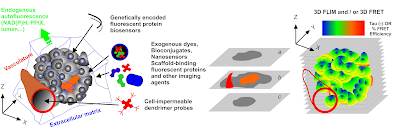
Together with Prof. Margarida Barroso (Albany Medical College, NY) and Prof. Xavier Intes (Rensselaer Polytechnic Institute, NY) we wrote a review article summarising biological aspects of applications of the fluorescence (FLIM) and phosphorescence (PLIM) lifetime imaging microscopies.  We covered most of FLIM and PLIM applications, including FLIM-FRET, macro-FLI, O2 and metabolic imaging, monitoring virus entry into the cell, imaging in organoids and tissue engineering and other areas. In addition, we outlined broad applicability of this type of microscopies not only for cancer and stem research (biomedicine) but also for fungal, plant and other 'general biology' areas.  The review published in the Journal of Cell Science can be assessed here . Twitter link  and link2

JoVE Methods collection: Quantitative live cell imaging of 3D models

Image
Together with Prof. Margarida Barroso (Albany Medical College), we guest edit a collection of video protocols, hosted by the Journal of Visualised Experiments ( JoVE ), and  dedicated to the quantitative live cell imaging in 3D .  We expect bringing together some leaders and innovators in various aspects of the quantitative live fluorescence microscopies applied to ex vivo animal models, organoids and 3D engineered tissue blocks. The collection, which just has been started, can be assessed here .