Posts

New PhD graduate from the Lab

Congratulations to Alicia H. Waters for successful defence of Ph.D. degree in biochemistry! Alicia was a member of the team in period 2011-2015. Her LinkedIn profile can be found here .

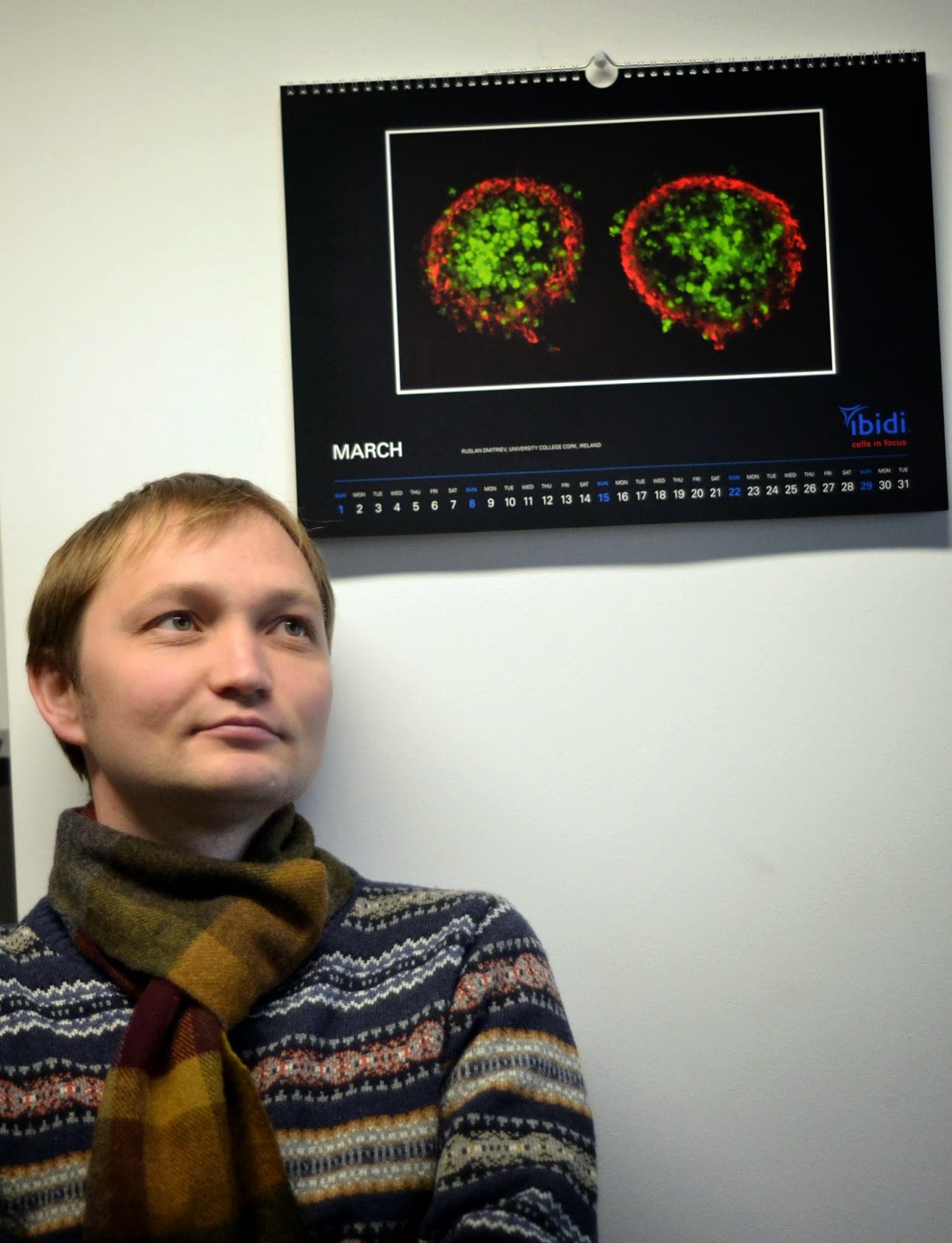
Microscopy image by lab member in the commercial calendar

Image
The fluorescence microscopy image of two neurospheres taken by Dr. Ruslan Dmitriev was chosen to appear on 2015 calendar by Ibidi  - a well-known company which manufactures consumables for cell and tissue culture. Neurospheres represent free-floating spheroid 3D model of neural stem cells which is characterised by presence of diverse cell types (neural progenitor cells, astrocytes, neurons). They are used for development of better therapies of stroke, studies of inflammation and other neuroscience and stem cell research areas. Dr. Dmitriev and his colleagues from UCC have developed a novel imaging method allowing for real-time analysis of neurosphere oxygenation correlated with cell viability and differentiation. More details on this work can be found here . This is a second time when microscopy work by Dr. Dmitriev's was chosen for calendars published by Ibidi .

Solid-State Oxygen Sensors Based on Phosphorescent Diiodo-Borondipyrromethene Dye

Dr. S. Banerjee and Prof. D. Papkovsky in collaboration with Tomsk State University (Russia) have published a joint research paper in Sensors and Actuators B journal. The article reports on evaluation of novel O2-sensitive phosphorescent indicator dye (I2-BODIPY) emitting in near infra-red part of electromagnetic spectra and having brightness and photostability comparable with existing state-of-the-art metalloporphyrin-based indicator dyes. This indicator dye has also long emission lifetimes (up to 300 microseconds) and can be exploited in design of novel O2 probes and sensors for biological detection. The full text of the paper can be found here .

New PhD graduate from the Lab

Alina Kondrashina has successfully defended her PhD thesis in biochemistry. Alina worked at Biophysics and Bioanalysis lab in period 2011-2014. Her Google Scholar profile can be found here . Congratulations to Alina and her supervisor, Prof. D. Papkovsky!

Photonics West 2015 conference

Prof. D. Papkovsky and Dr. R. Dmitriev attended the Photonics West-2015 conference (section "Bios", 7-12 February 2015, San Francisco) organised by Society for Photo-Optical Instrumentation Engineers (SPIE). This is one of the largest scientific symposia in the areas of photonics/ biophotonics. Both D. Papkovsky and R. Dmitriev have presented talks on the recent developments in the area of nanoparticle-based O2 imaging. More information on conference can be found here . Published conference proceedings are available: Multi-parametric imaging of tumor spheroids with ultra-bright andtunable nanoparticle O2 probes Imaging of oxygenation in 3D tissue models with multi-modalphosphorescent probes

Hybrid scaffolds for O2 sensing in 3D cell cultures

PhD candidate J. Jenkins, Dr. R. Dmitriev, Prof. D. Papkovsky and co-authors published joint research paper describing use of polymeric 3D scaffolds for mammalian cell culture for measurement of localised (pericellular) O2 levels with various cell models including cancer cells, multi-cellular aggregates and cultured brain slices. This method allows for better analysis of cell function and viability and can be combined with various other assays (study of cell differentiation) and pharmacological treatments (hypoxia-specific drugs), when performed on one-photon confocal PLIM microscope. The research is published in Acta Biomaterialia journal and can be found found here .
Energy budget platform for assessment of cell metabolism (protocol)

Dr. A. Zhdanov and Prof. D. Papkovsky have contributed to the book "Mitochondrial medicine" (Series "Methods in molecular biology", Vol. 1265, published by Springer publishing house in 2015). This chapter describes the protocol allowing to analyse cell energy production pathways including glycolysis, Krebs cycle and oxidative phosphorylation, using easy-to-use commercially available phosphorescent pH and O2-sensitive probes. The full text of book chapter can be found here .