Posts

Biophysical Society 60th Annual Meeting

Meet us at Biophysical Society Meeting , which will take place in Los Angeles Convention Center from 27-February till 3-March! Dr. R. Dmitriev and PhD candidate J. Jenkins will give oral and poster presentations in section "Biosensors". Presentation 1 Presentation 2
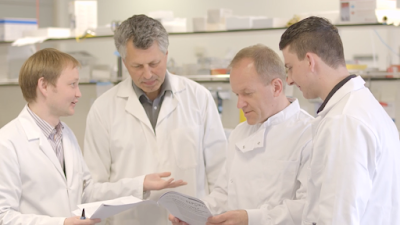
Prof. D. Papkovsky speaking about his work

Image
Left to right: Dr. R. Dmitriev, Prof. D. Papkovsky, Dr. A. Zhdanov and J. Jenkins A new promotional video describing the joint research of Biophysics and Bioanalysis Lab with Irish Photonic Integration Centre (IPIC, Tyndall-UCC).     The IPIC Team - Dmitri Papkovsky from Standpoint Media on Vimeo .

Metallochelate Coupling of Phosphorescent Pt-Porphyrins to Peptides, Proteins, and Self-Assembling Protein Nanoparticles

Dr. R. Dmitriev, N. O'Donnell and Prof. D. Papkovsky published research in Bioconjugate Chemistry journal reporting new approach to construct phosphorescent O2-sensitive materials for biological imaging: they found that the metal chelation, widely used for immobilisation of proteins, is also compatible with the use of Pt-porphyrins for quantification of molecular oxygen. Team successfully demonstrated specific and non-covalent coupling of Pt-porphyrins to various types of biomolecules - peptides, proteins and self-assembling protein nanoparticles. After coupling, Pt-porphyrins retained their photophysical properties and were compatible with various measurement methods, such as microplate reader and fluorescence microscope. This study provides a framework for design of advanced protein- and peptide-based biosensors and should facilitate further progress in imaging tissue O2. The full text can be found here . The article is now part of special issue entitled ' Molecular imagi...

Hypothermia protects brain mitochondrial function from hypoxemia in a murine model of sepsis

Prof. D. Papkovsky in collaboration with team from University College London (UK) have participated in joint research project, addressing the effects of vascular oxygen in mouse model of sepsis. The work was published in Journal of Cerebral Blood Flow & Metabolism . Free full text can be found here .

Oxygen in islets

Image
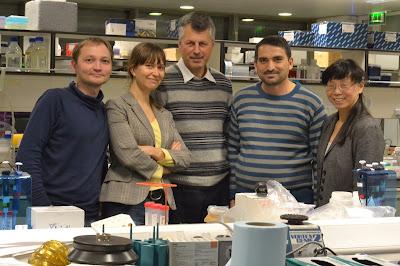
Dr. Ying Yang ( Reader in Biomaterials and Tissue engineering, Keele University, UK ) has recently visited the lab, for joint experiments on analysis of oxygen consumption in 3D models of pancreatic islets by PLIM microscopy. From left to right: Dr. R. Dmitriev, Dr. I. Okkelman, Prof. D. Papkovsky, A. Elttayef, Dr. Y. Yang.  

Measurement of ROS Levels and Membrane Potential Dynamics in the Intact Carotid Body Ex Vivo

Prof. D. Papkovsky and collaborators from Institute of Physiology (Essen, Germany) have contributed to the book chapter on the method of multi-parametric analysis of reactive oxygen species (ROS) in ex vivo culture of carotid body. This is the chapter from the book "Arterial chemoreceptors in physiology and pathophysiology" recently published by the Springer Publishing House. The full text can be found here .

Imaging of oxygen gradients in giant umbrella cells: an ex vivo PLIM study

Members of the lab Dr. A. Zhdanov, I. Okkelman and Prof. D. Papkovsky in collaboration with Prof. J. Cryan's lab from APC Microbiome Institute have published the research article devoted to study of intracellular oxygen (O2) gradients. While the existence of dynamic O2 gradients is a controversial topic, Zhdanov et al found that giant umbrella cells from mouse bladder epithelium display profound O2 gradients in ex vivo culture. Using confocal phosphorescence lifetime imaging microscopy (PLIM) and recently developed O2-sensitive Pt-Glc probe, they observed significant (up to 85 uM) lateral O2 gradients. Such gradients are presumably produced by mitochondrial respiration, as the authors demonstrated. The work was published in American Journal of Physiology - Cell Physiology. The full text can be found here . The image from the article was chosen as the "Image of the week" in the social media of the AJP Cell Physiology, on 14th of August.