Posts

New appointment for Dr. Ruslan Dmitriev
Image
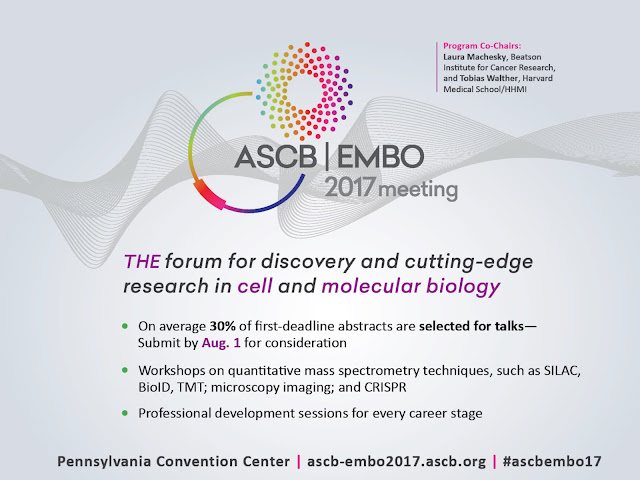
Dr. Ruslan Dmitriev , head of Metabolic Imaging Group was recently honoured to serve as local Ambassador of the American Society for Cell Biology (ASCB). ASCB represents one of the largest societies in cell biology (>11,000 members worldwide) with primary mission to study the cell as fundamental unit of life. The Society has major interests in improving the ways of assessing the research, addressing the key scientific policy issues, advocating increased research funding, supporting leadership and mentorship, and more. ASCB is involved in number of activities supporting the research life of women in science, summer career development and education workshops, minorities’ affairs etc. It provides resources such as Career Advice for Life Scientists collection, recognizes outstanding members of community, supports individuals and groups with grants. This year’s Annual Meeting will be jointly organized by ASCB and EMBO and will be held in Philadelphia, USA, on December 2-6...
International Society for Stem Cell Research (ISSCR 2017)

Image
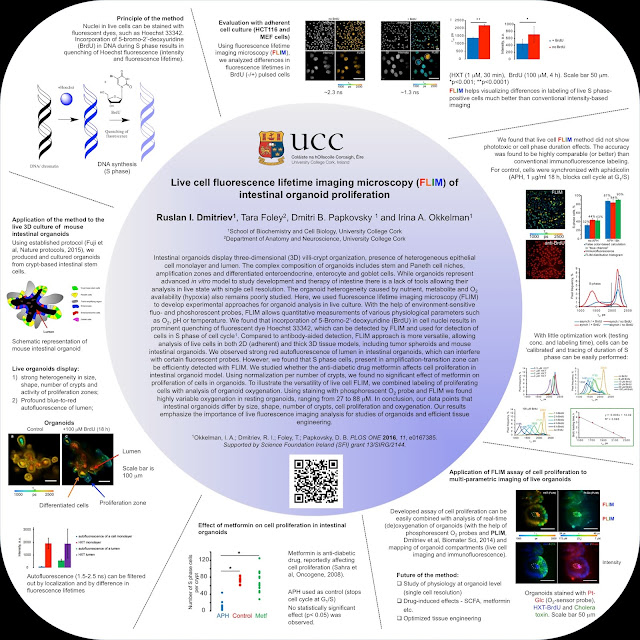
Dr. Ruslan Dmitriev has attended the ISSCR 2017 meeting, which was held in Boston (13-18 June). ISSCR meeting is a global event for specialists working in stem cell research, cancer and regenerative medicine, gathering ~ 3,900 participants from all over the world. Dr. Dmitriev presented the poster on new FLIM method allowing high-resolution live cell microscopy of S phase positive cells. The method is broadly compatible with 2D and 3D cultures including mouse intestinal organoids and is expected to have broader in vivo application in stem cell research area. Downloadable version of poster:

new PhD from the lab

Image
Congratulations to Rebecca McQuaid with successful defence of her PhD thesis (PhD in physics) at her 'home' University College Dublin! Rebecca's PhD was partly based on the collaborative work between Metabolic Imaging Group  (Dr. R. Dmitriev), Prof. D. Papkovsky and Group of Dr. Brian Vohnsen (UCD) on the control of corneal cross-linking using O2-based PLIM microscopy and nanoparticle-based phosphorescent probes.

2nd Workshop on advanced time-resolved imaging techniques

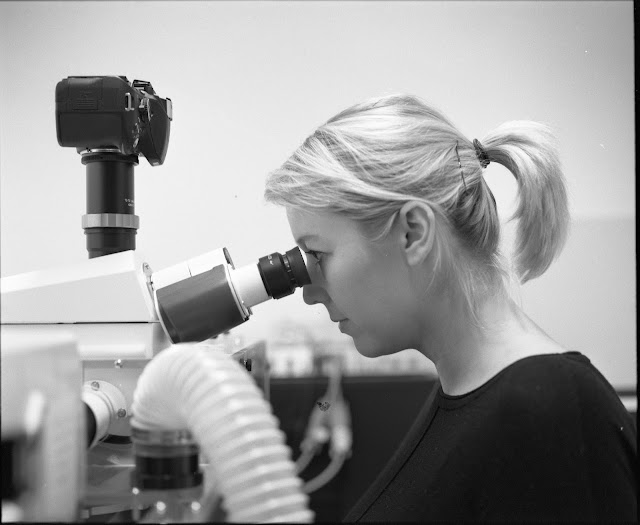
Dr. R. Dmitriev attended (invited speaker) the 2nd workshop on advanced FLIM & PLIM applications organised in BioCev, Vestec (Czech Republic). He presented a talk on multi-parametric FLIM-PLIM microscopy and combining the high-resolution O2 measurements with analyses of temperature and cell cycle by these methods in 3D tissue models of cancer and stem cells. This workshop organised by Becker & Hickl GmbH gathers some world-leading (from USA to Australia) experts in microscopy and time-correlated single photon counting. More info on this event can be found here . 

The pioneer of intracellular O2 gradients studies visits the lab

Image
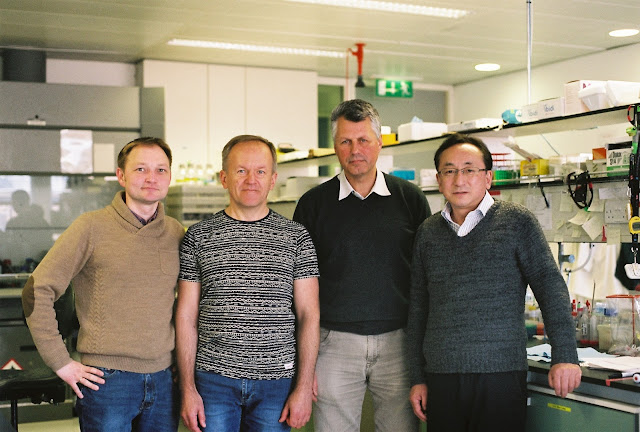
Prof. Eiji Takahashi (Saga University, Japan) recently visited the Laboratory of Biophysics & Bioanalysis/ Metabolic Imaging Group and presented the seminar at School of Biochemistry and Cell Biology of University College Cork. Prof. Takahashi is world-renown pioneer in studies of intracellular O2 gradients and their role in various cell-based models, such as cardiomyocytes. During his visit, Prof. Takahashi and members of the lab discussed their research and possible future plans for collaborations.  (from left to right): Dr. R. Dmitriev, Dr. A. Zhdanov, Prof. D. Papkovsky, Prof. E. Takahashi Prof. D. Papkovsky and Prof. E. Takahashi

'yoga for polymers': is it good for creating biosensor?

Dr. I. Okkelman, Dr. S. Banerjee, Prof. J. Kerry, Prof. D. Papkovsky and collaborators from Moscow State University (Russia) have published a new research article, investigating the effect of polymer stretching (hard elastic polymer materials) on analytical performance of incorporated phosphorescent O2-sensitive dyes. They found that polymer materials can display mechano-sensitive reversible response in terms of O2 sensitivity (intensity, phosphorescence lifetime and quenching constant). This finding is expected to be highly useful in design of high-performance O2-sensing materials (solid state sensors) for food safety, industrial and biological applications. The work was published in prestigious ACS Applied materials & interfaces journal.

Steering surface topographies of electrospun fibers: understanding the mechanisms and application to O2 sensing

Dr. R. Dmitriev, Dr. J. Jenkins and Prof. D. Papkovsky have co-authored the new study on design of polymer nanofiber matrices, produced by electrospinning method, for advanced applications such as tissue engineering, drug delivery and optical biosensing. The collaborative multi-disciplinary work between Empa (Swiss Federal Laboratories for Materials Science and Technology, Switzerland) and Laboratory of Biophysics and Bioanalysis/ Metabolic Imaging Group (UCC) demonstrated the rational design of polymer-based nanofiber materials with controlled surface topography and its application for imaging of pericellular O2 in 3D cancer cell model. The article has been published in Scientific Reports journal. Full text is available here .