Posts

A novel effect of DMOG on cell metabolism: direct inhibition of mitochondrial function precedes HIF target gene expression

Drs. A. Zhdanov, I. Okkelman and Prof. D. Papkovsky in collaboration with Dr. S. Melgar (Alimentary Pharmabiotic Centre, UCC) published a joint research paper reporting the HIF-independent effect of dimethyloxalylglycine (DMOG) on cell metabolism in Biochimica et Biophysica Acta (BBA) - Bioenergetics Journal. Over the recent years, DMOG was commonly used to inhibit HIF (Hypoxia Inducible Factor) pathways through inhibition of prolyl hydroxylases without paying attention to its direct inhibition of mitochondrial respiration - presumably through inhibition of "glutamine/ 2-oxoglutarate metabolic axis", as the authors suggest. The full-text of the article can be found here .

Graduation of Drs. Alicia H Waters and Alina V. Kondrashina - 180615

Image
Congratulations to two fresh PhDs from the Lab, who were officially graduated last week. Congratulations to supervisor, Prof. D. Papkovsky! Best of luck Alina and Alicia in your future career(s)! Below are some photographs from the event:  Dr. A. Kondrashina with supervisor, Prof. D. Papkovsky  Dr. A. Waters and Dr. A. Kondrashina Dr. A. Kondrashina

Keystone Conference on Hypoxia, Dublin 12-17 May

Image
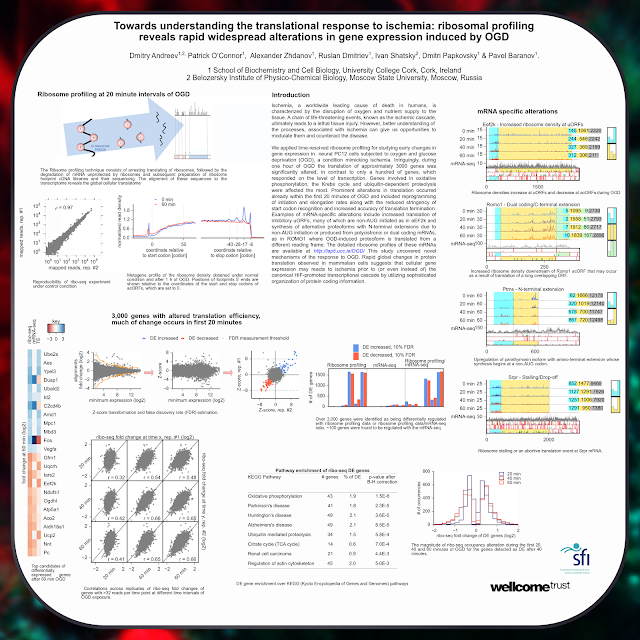
Prof. D. Papkovsky and Dr. A. Zhdanov attended the Keystone conference "Hypoxia: from basic mechanisms to therapeutics" which took place in Dublin, 12-17 May. They presented poster describing ribosome profiling study of global translation response to ischemia (recently published Genome Biology journal) and another poster on discovery of oxygen gradients in murine bladder umbrella cells (manuscript in preparation). Below is the poster on ribosome profiling:

Global translation response to brain ischemia, observed with neural PC12 cells

Dr. A. Zhdanov, Dr. R. Dmitriev and Prof. D. Papkovsky in collaboration with Dr. P. Baranov " LAPTI " group (University College Cork) and Moscow State University (Russia) have published joint research paper entitled "Oxygen and glucose deprivation induces widespread alterations in mRNA translation within 20 minutes" in Genome Biology  open access journal. The team has focused efforts on novel technique - ribosome profiling - to determine immediate effects of cellular stress occurring during ischemia (oxygen and glucose deprivation) on global protein translation. Some of the key findings of the study are: -the indication of immediate cellular response, independent from well-known Hypoxia Inducible Factor (HIF) pathway; -short-list of the key genes which translation is changed upon ischemia and -widespread occurrence of non-canonical translation initiation that can lead to synthesis of "stress-induced" forms of proteins. Collectively, this data should...

Intracellular probes for imaging oxygen concentration: how good are they? (review)

Dr. R. Dmitriev and Prof. D. Papkovsky have jointly co-authored review article in Methods and Applications in Fluorescence journal (IOP publications). The article provides short and concise overview of nearly all existing and optical luminescent probes suitable for quantification of intracellular oxygen in living cells. While the number of "novel O2 sensors" appears in the literature every year (at least 2-5 O2 probes per year), the critical analysis and cross-comparison between existing small molecule and nanoparticle sensor probes are normally missing. The review tries to perform classification among all the reported structures to answer such questions as "toxicity", "cell specificity", "best suitable biological model" etc. This review complements the previously published review articles on exhaustive classification of biological applications of quenched-phosphorescence O2 sensors and probes ( Papkovsky and Dmitriev, Chemical Society Review...

Versatile Conjugated Polymer Nanoparticles for High-Resolution O2 Imaging in Cells and 3D Tissue Models

It is well-known that the fluorescent and phosphorescent nanoparticle sensor probes are a powerful imaging tool to study the physiology at the level of live cells and tissues. They are bright, exceptionally photostable and can be compatible with multiple detection modes - "multi-modal" probes - for quantitative measurements. However, they are often tailored to particular cell model and their targeting to specific cell types represents a challenging task. To address this, Dr. S. Borisov (Graz University of Technology), Dr. R. Dmitriev and collaborators from Graz University of Technology (Austria), UCC, RCSI (Dublin) and Pirogov Russian State Medical University (Russia) introduced a new concept of copolymer nanoparticles for O2 sensing. These nanoparticles are based on two dyes (antenna and porphyrin) with controlled FRET leading to improved (5-10 times) brightness and two-photon absorption, in comparison to any existing Pt-porphyrin-based O2-sensitive nanoparticles. On the o...

Advanced Time-Correlated Single Photon Counting Applications (book chapter)

Image
PhD candidate James Jenkins, Dr. Ruslan Dmitriev and Prof. Dmitri Papkovsky have contributed to  the book "Advanced Time-Correlated Single Photon Counting Applications", recently published by Springer (series Chemical Physics, Volume 111, 2015). The book chapter entitled "Imaging cell and tissue O2 by TCSPC-PLIM" (pages 225-247) describes general protocols, methods and probes/ sensors suitable for real-time analysis of live cell and tissue oxygenation with broad variety of 2D and 3D models. TCSPC is a modern method allowing simultaneous measurements of both fluorescence and phosphorescence lifetimes of excited dyes. This can be applied for quantitative detection of O2, pH, Ca2+ and other physiological parameters. The book chapter and the book can be accessed here .