Posts

IPIC Industry workshop best publication in 2018 award for Dr. Irina Okkelman
Image
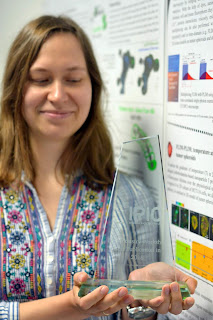
Dr. Irina Okkelman's work at the Irish Photonic Integration Centre (IPIC) / UCC has been acknowledged by the 'Best publication award in 2018' prize. For this contest, Irina submitted our recent work on the design of cellulose-based biosensor scaffolds for imaging of various tissue-engineered constructs ( O'Donnell et al, Acta Biomaterialia, 2018 ).  The award ceremony was held on 21-Mar-2019 in Aula Maxima, University College Cork.
Update on the blog function

Since June-2019 our blog will mainly focus on the research activity of Dr. Ruslan Dmitriev's group. If you are interested in research activity of Prof. Dmitri Papkovsky (Laboratory of Biophysics and Bionalalysis, University College Cork), please visit his official webpage: http://publish.ucc.ie/researchprofiles/D003/dpapkovsky

Sechenov Biomedical Summit 2019: Moscow, 20-21 May.

Image
Dr. R. Dmitriev organised, chaired and gave an invited talk at the Sechenov Biomedical Summit 2019 conference. His section 'Functional imaging in tissue engineering and regenerative medicine' gathered world-known experts in the areas of intestinal organoid and stem cell niche metabolism, non-invasive imaging in tissue engineering and development of novel fluorescent protein-based biosensors. Dr. Dmitriev's talk was on visualization of stem cell niche by the fluorescence lifetime imaging microscopy (FLIM). The details of the section can be found here: The conference website: https://sechenov-sibs.confreg.org

Amsterdam Stem cell and organoid symposium (20-22 Feb 2019)

Image
Dr. R. Dmitriev will attend the Stem Cells & Organoids in Development and Disease symposium, where he will present a poster on the visualisation of stem cell niche by the multi-parametric FLIM approach. This international meeting promises to be one of the main events in the organoids science in 2019. More information and program can be found here . The program & abstracts are available  as PDF.

New Ph.D. from the lab!

Image
Neil O'Donnell (supervised by Dr. R. Dmitriev and Prof. D. Papkovsky ) has successfully defended his Ph.D. thesis on 22-Jan-2019! Neil's Ph.D. project ('New biosensors for metabolic imaging', 2014-2018) was funded by the Science Foundation Ireland (SFI) SIRG grant and focused on development, evaluation and application of biosensors, based on advanced coupling chemistry and various recombinant proteins. Neil participated in the following projects: 1. Metallochelate coupling of Pt-porphyrins to peptides, proteins and self-assembling protein nanoparticles for advanced biosensing applications. Published in Bioconjugate Chemistry journal. 2. pH-sensitive fluorescent protein-based nanoparticles for imaging of cancer and neural cells (unpublished). 3. Book chapter on the available biosensors for imaging of 3D tissue models. 4. Cellulose-binding domain fused with fluorescent proteins as a tool for design of hybrid 'biosensing' scaffolds for tissue engine...

new horizons for FLIM research

Image
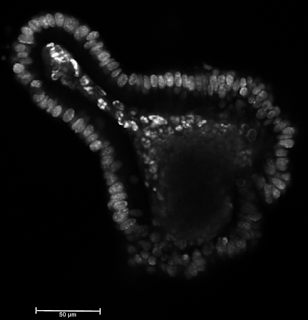
In Jan-2019, Dr. Ruslan Dmitriev visited the Leica training Centre in Germany, where he tested the new platforms for confocal and multiphoton FLIM imaging, based on Leica Falcon SP8 system. In collaboration with Dr. H. Glauner, he tested the methods of labelling cell proliferation by FLIM, NADH autofluorscence FLIM and some other approaches with the culture of live intestinal organoids. White light laser- and multiphoton-based (Dive) Falcon SP8 microscopes were found to be  excellent tools for studying three-dimensional complex structure of live intestinal organoids. Pictured below: 3D reconstruction of FLIM images of live organoid with labeled proliferating and stem cells. Twitter link .

Background-free fluorescence-decay-time sensing and Imaging of pH with new generation of red fluorescent dyes

Dr. Ruslan Dmitriev recently collaborated with TU Graz and PCO AG, in research article targeting development of novel, highly photostable red fluorescent pH-sensitive dyes with extended fluorescence decay times (~7-12 ns). The team focused on the family of diazaoxotriangulenium dyes, as perspective biosensing materials for cell and environmental applications. The research was published in Analytical Chemistry journal. Twitter link.